


Flavor science with FUSION PTR-TOF
Exploring aromas and aftertaste phenomena with high-resolution mass spectrometry
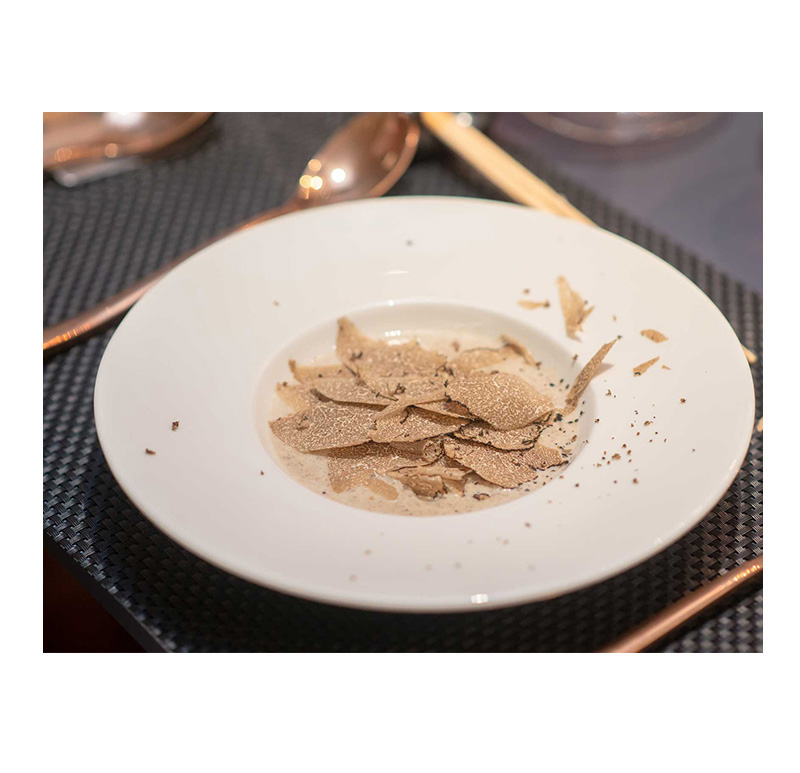
The FUSION PTR-TOF 10k was recently used in a real-time nosespace study investigating the causes of bad aftertaste in ten soups, each seasoned with a different commercial truffle product, as well as with genuine black and white truffles.
The example of truffle soup was used in order to present the new possibilities in flavor science and flavor analysis by utilizing our FUSION PTR-TOF 10k, which is the current benchmark for PTR-MS instruments, offering a mass resolution of approximately 15,000 m/Δm and sensitivities of up to 80,000 cps/ppbv.
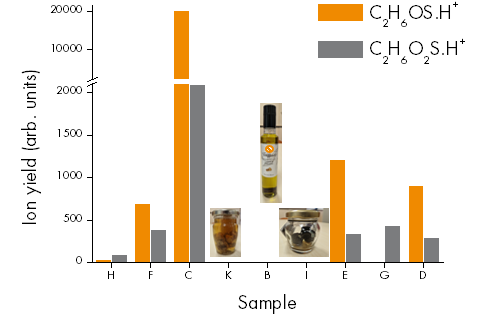
It is well-known that most truffle flavored products, such as oils and pastes, get their characteristic aroma from a more or less complex mixture of food chemicals rather than from real truffles. According to literature, the compounds dimethyl sulfoxide (C2H6OS) and dimethyl sulfone (C2H6O2S) cannot be found in natural truffles and thus, their presence in truffle oil can be interpreted as evidence of artificial flavoring. Indeed, none of the two molecules could be detected neither in pure white (sample K) nor pure black truffles (I), but were present in various concentrations in seven out of eight truffle products, with the exception being one white truffle oil (B). However, with an unnaturally high concentration of 2,4-dithiapentane and the absence of 2-acetly-5-methylfuran (naturally occurring in white truffle) also sample B almost certainly is artificially flavored. (Fig. 1)
While consuming food refined with artificial truffle aroma, many report a rather pleasant first flavor sensation that successively evolves into an increasingly disagreeable experience. To explore the phenomenon of the bad aftertaste we performed online Proton-Transfer-Reaction Mass Spectrometry (PTR-MS) analysis using the FUSION PTR-TOF 10k. A test subject's nosespace was analyzed in real-time during the consumption of a series of homemade truffle soups.
Persistence of flavors
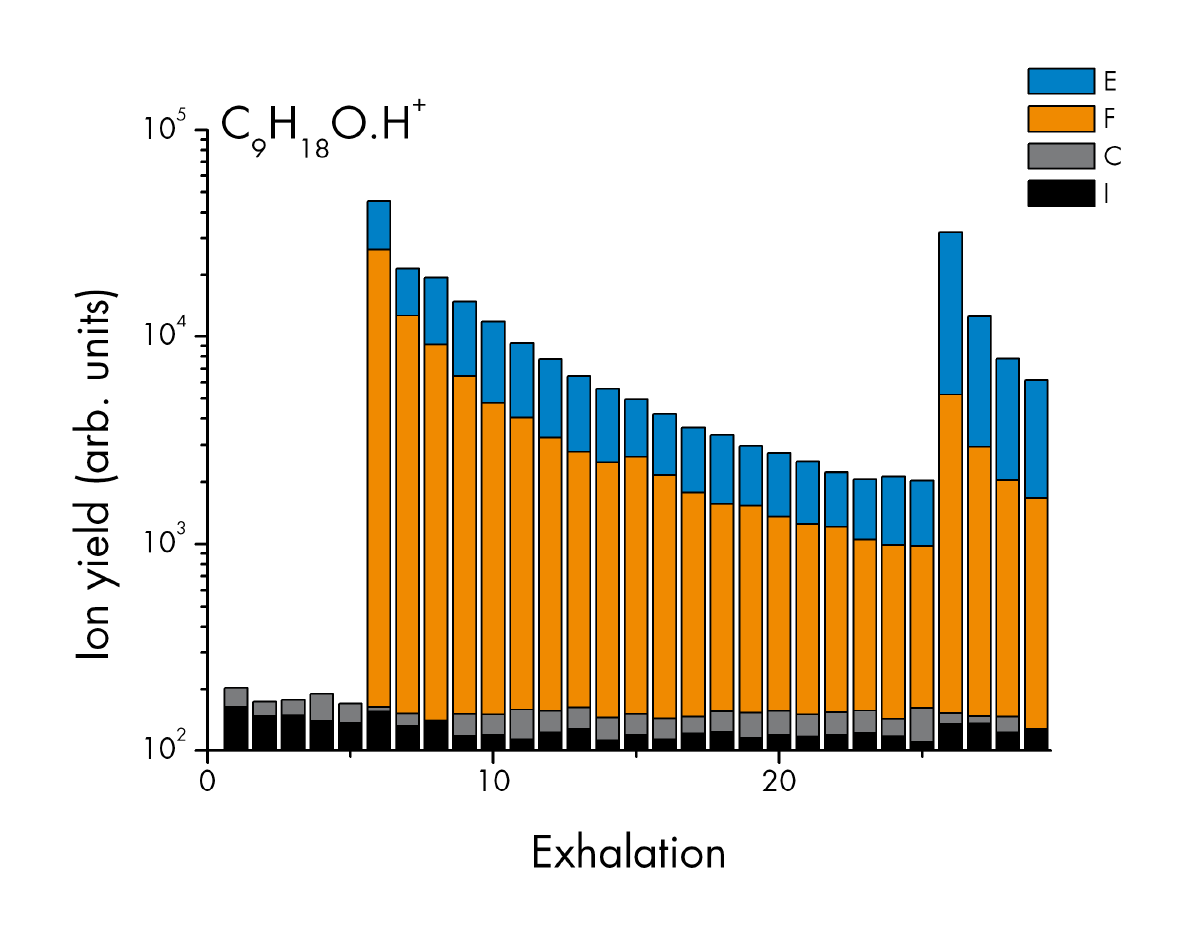
Ten truffle soups were prepared and repeatedly tasted during nosespace sampling. After the first sip, complex flavor mixtures were detected by the FUSION PTR-TOF; however, most compounds disappeared within seconds.
Interestingly, some compounds seemed to be more persistent, such as C9H18O (tentatively identified as nonanal). For instance, in black truffle flavor samples E (in olive oil) and F (in rapeseed oil) C9H18O persisted through over 20 exhalations (sip of truffled soup at 6). In contrast, sample C (black truffle flavor in olive oil from a different manufacturer) and pure black truffle soup I showed no amounts of C9H18O traceable at any point. (Fig. 2)
Flavor mix comparison
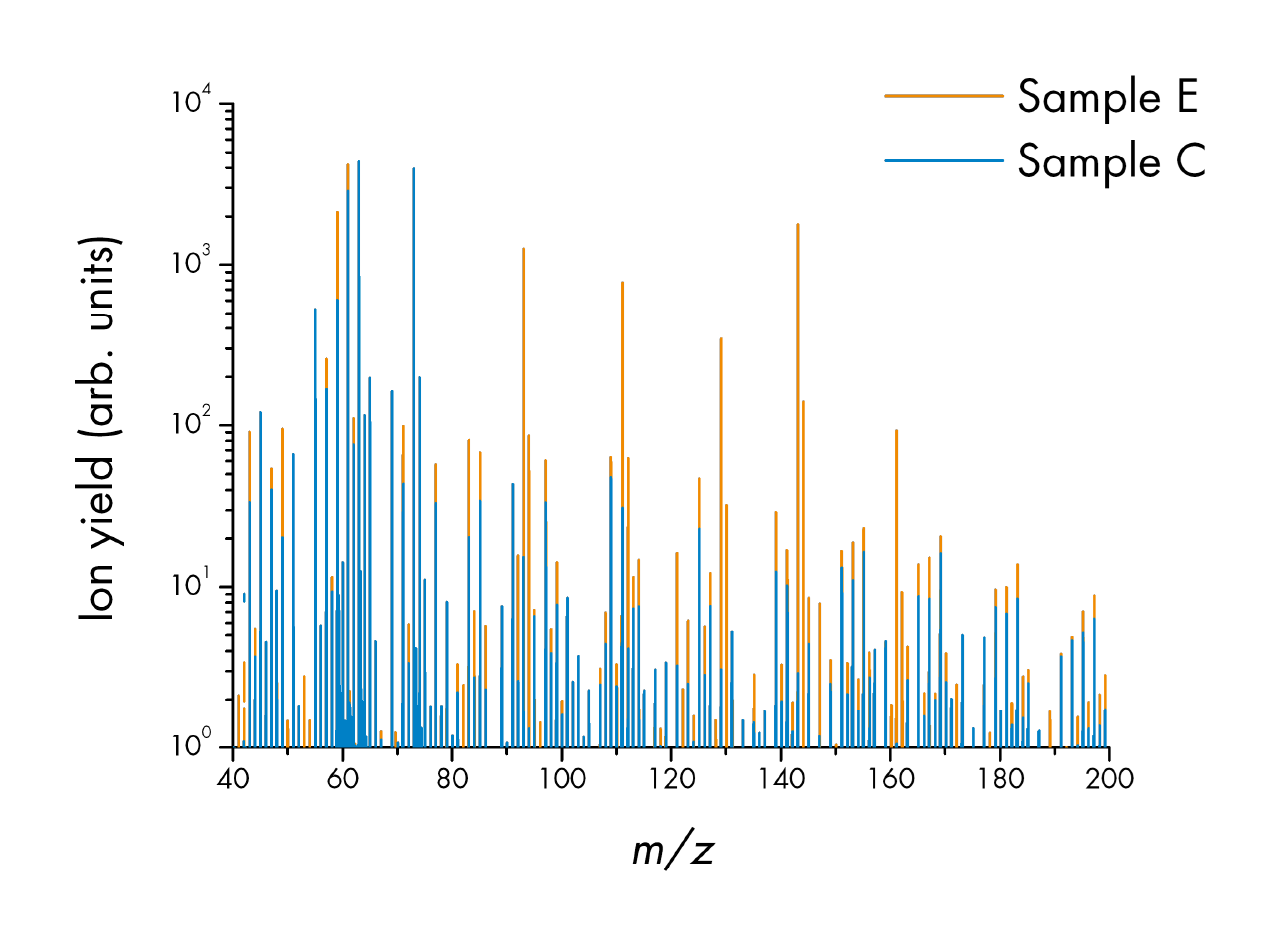
We compared also two black truffle oils (samples C and E) to determine whether different manufacturers use the same flavor mix.
Both samples had a truffle-like taste and aroma. C tasted fresh, spicy, garlicy, pleasant whereas E had an earthy, dull, flat and thus increasingly unpleasant aftertaste.
The headspace mass spectra of soups made with samples C and E revealed that sample E contained higher concentrations of a broader variety of compounds. C9H18O.H+ was particularly abundant in sample E, while dimethyl sulfide (C2H6S.H+ "sharp green cabbage" taste) was dominant in sample C. (Fig. 3)
Conclusions for food analysis using nosespace studies
After the study we can conclude that all tested truffle products contain artificial flavoring rather than natural truffle aroma. Different manufacturers use different compound mixtures to mimic a certain truffle variety. These compounds can be well identified in the mass spectra. Furthermore, many of these compounds are very persistent in the nosespace and can be detected at elevated concentrations for minutes after ingestion of a single sip of truffled soup.
The utilized FUSION PTR-TOF 10k provides high mass resolution which is crucial for nosespace studies. The utilized instrument is perfectly suited for the separation of complex mixtures and real-time analysis and can therefore provide with valuable insights in food and flavor analysis.