Exploring the complex fragrance release dynamics of a luxury perfume
Perfumes are among the most intricate chemical compositions in the consumer world. Far from being simple liquids, they are sophisticated masterpieces consisting of dozens – often hundreds – of individual volatile organic compounds (VOCs). Generally, the prestige and perceived quality of a fragrance correlate with its chemical complexity; high-end perfumes utilize a vast array of natural and synthetic essences to create a deep, multi-layered olfactory experience.
The Dynamics of Scent: The Perfume Pyramid
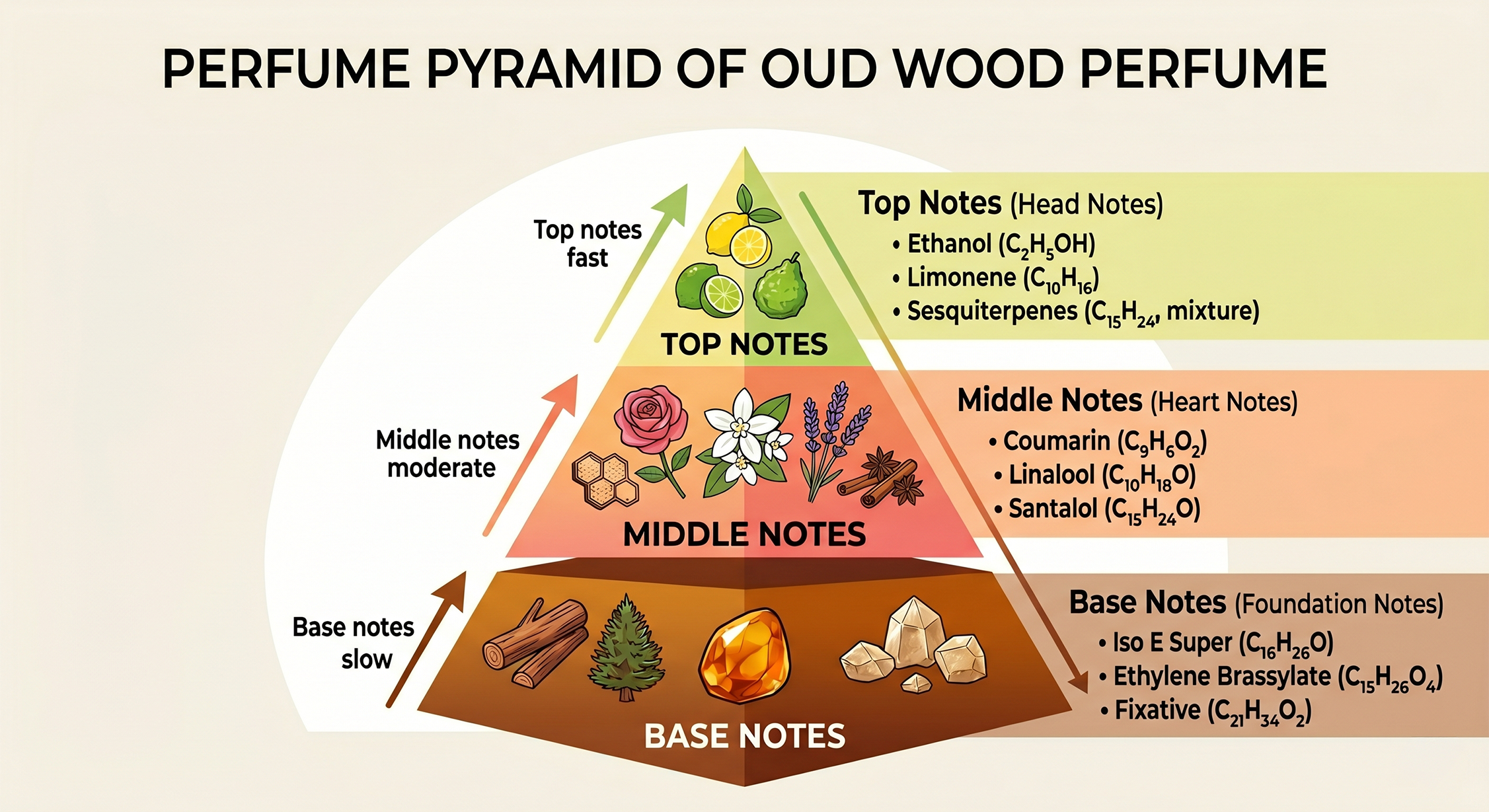
A fragrance is never static. Its character evolves over time as different components evaporate at varying rates. This progression is scientifically categorized using the Perfume Pyramid, which describes the three distinct phases of a scent’s life:
- Top Notes (Head): The initial, lightest smells (like citrus or herbs) that are perceived immediately upon application but evaporate quickly.
- Heart Notes (Middle): The "soul" of the perfume (often florals or spices) that emerges as the top notes dissipate.
- Base Notes: The heaviest molecules (such as musk or resins) that provide depth and can linger for days.
To truly understand and quantify this dynamic behavior, researchers require more than just a "snapshot" of the chemical makeup. They need a technology capable of monitoring these shifting concentrations continuously and in real-time.
The Solution: IONICON PTR-TOFMS
In this Application Note, we demonstrate that IONICON PTR-TOF is the definitive tool for fragrance analysis. By providing high-resolution data without the need for complex sample preparation, PTR-TOFMS captures the entire lifecycle of one of the highest quality and most luxurious perfumes.
This study demonstrates the unique capabilities of PTR-TOF-MS in fragrance R&D, offering a level of insight that traditional methods cannot match:
- 24/7 Continuous Monitoring for One Week: Capture the entire olfactory journey – from the first spray to the final base note – with uninterrupted data collection for one week.
- Broad Dynamic Range: Simultaneously detect and quantify high-concentration solvents and ultra-trace aromatic compounds across multiple orders of magnitude.
- High Mass-Resolution: Effortlessly resolve complex chemical signatures and identify isobaric compounds thanks to superior mass resolution.
- Set-and-Forget Stability: Benefit from rock-solid instrument performance and consistent data quality over long-term measurements.
- Instant Direct Sampling: Experience the most straightforward "plug-and-play" analysis imaginable with direct headspace injection – no sample preparation, no artifacts.
Unveiling the Fragrance Lifecycle
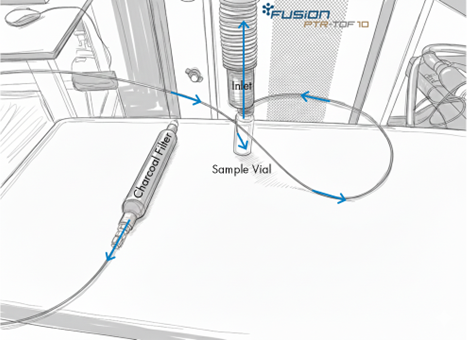
The experimental setup is as simple as it can get (compare Fig. 1). Some micro-droplets of one of the top-rated "Oud Wood" perfumes were placed in a vial, which was then sealed with a septum. A gas line connected to a charcoal filter and the PTR-TOF inlet line were pierced through the septum in order to continuously analyze the dynamic headspace over a total duration of about one week. The utilized FUSION PTR-TOF 10 was tuned for a mass resolution of about 12.000 m/∆m to perfectly separate the numerous isobaric compounds in the complex perfume matrix.
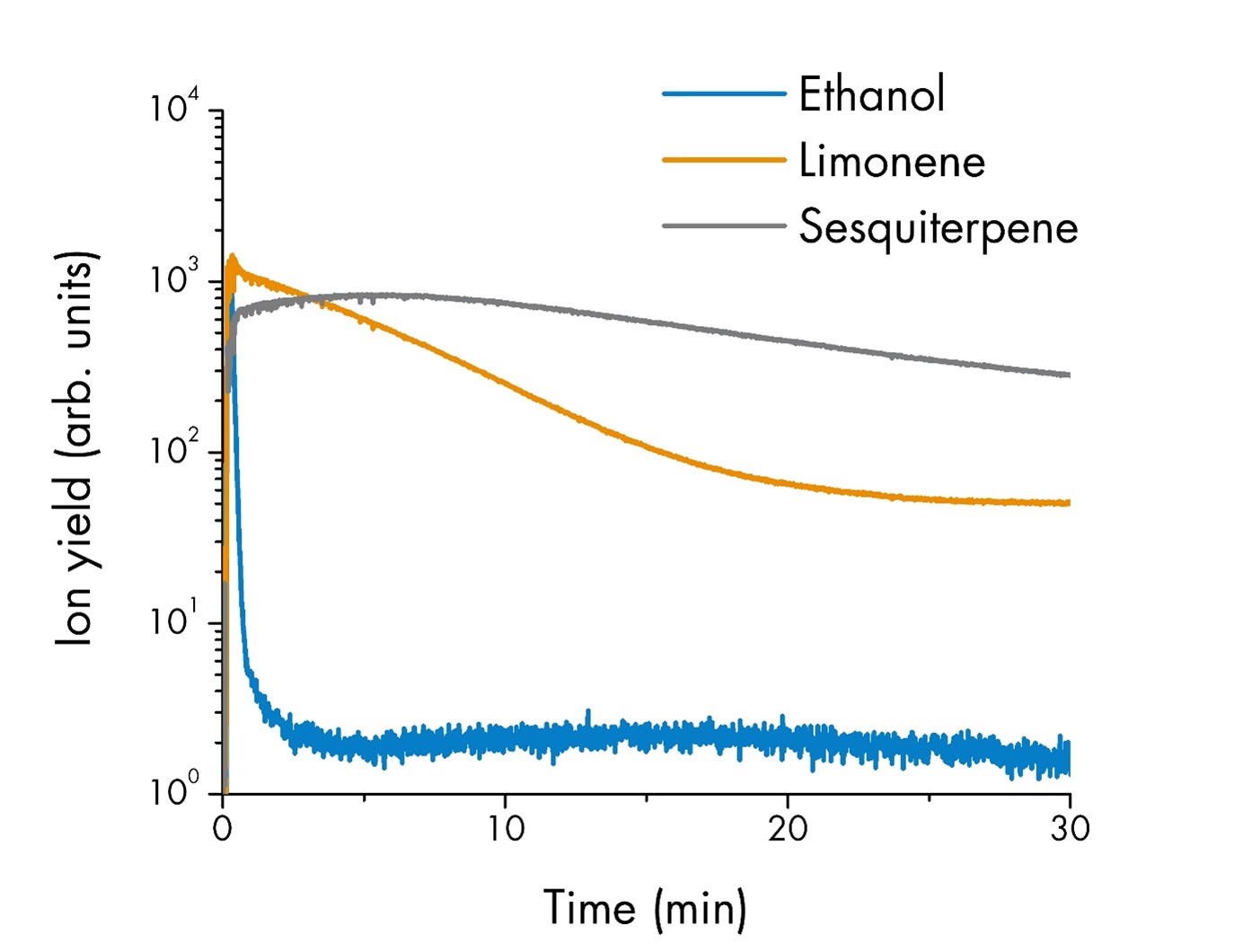
The fundamentally different evaporation behavior of the various perfume ingredients becomes apparent already within the first few minutes (Fig. 2). While the solvent ethanol drops to less than half its original concentration within seconds and reaches background levels (i.e., it is completely evaporated) after about one minute, the concentration of limonene decreases much more slowly. This citrus Top Note halves in intensity within about 5 minutes. Note: We identify the detected signal for protonated monoterpenes at m/z 137.133 as mainly limonene because it is listed as an ingredient for this perfume.
Sesquiterpenes (C15H24), on the other hand, take several minutes to reach their maximum intensity and remain at a considerable concentration for several hours. Thus, they contribute to the Top, but also to the Heart Note of the perfume.
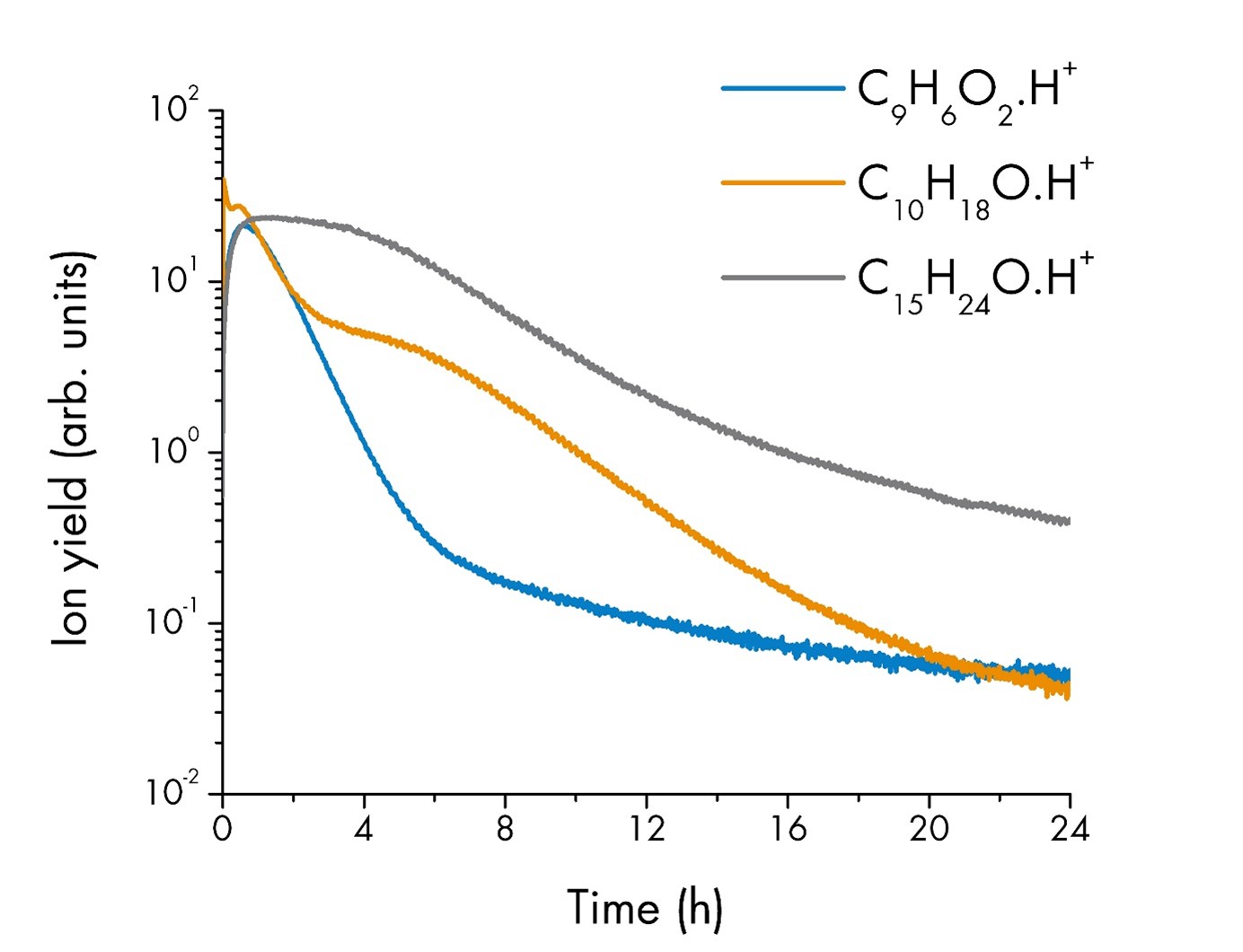
Ion signals for C9H6O2.H+, C10H18O.H+, and C15H24O.H+ are tentatively identified as the vanilla-like coumarin, the rose alcohol linalool, and the sandalwood compound santalol, respectively. While linalool is present at maximum intensity right at the beginning and decreases in "steps" over the 24 h shown in Fig. 3, coumarin and santalol take about 40 min to reach their maxima. All three compounds can be considered as Heart Notes, but the sandalwood fragrance contributes most also to the Base Note.
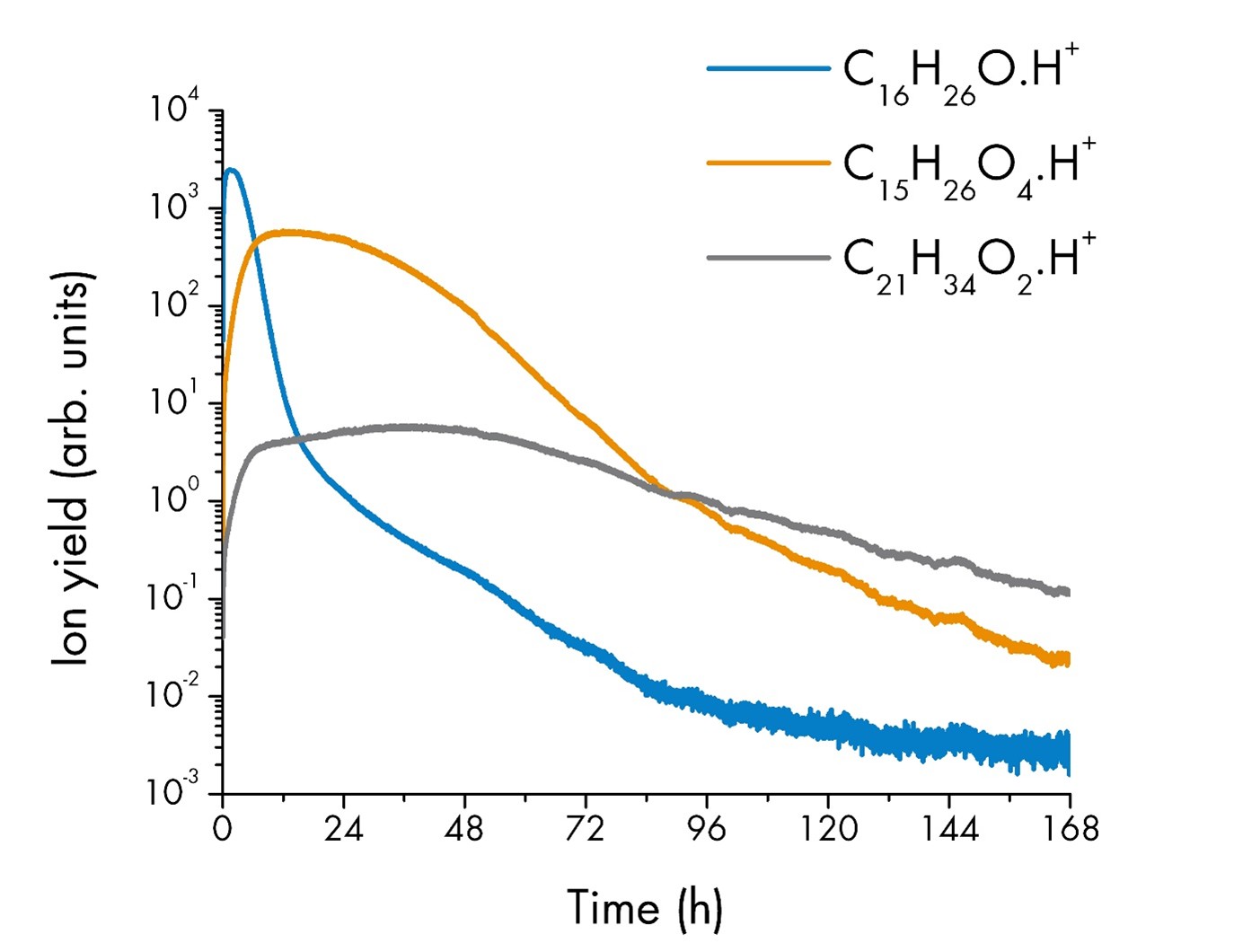
The woody odorant "Iso E Super" (C16H26O) is widely used in the perfume and cosmetics industry. In our Oud Wood perfume, it is one of the most abundant compounds in the headspace, reaching its maximum after over an hour and plateauing for about another hour afterwards (Fig. 4). However, probably the most persistent fragrance compound is ethylene brassylate (C15H26O4.H+), a slightly sweet, flowery synthetic musk. This Base Note is present at a considerable concentration for days.
Finally, the longest lasting substances detectable in the perfume's headspace are fixatives, resin derivatives like C21H34O2 or C21H32O2 (methyl abietate, not shown), which are virtually the "last men standing".
Conclusions and Outlook
Obviously, the presented results are just some illustrative examples out of the rich variety of detected perfume compounds. Nevertheless, it should already be clear at this point that only IONICON PTR-TOF can capture the entire fragrance lifecycle, from the rapid intensity changes in the first few minutes to the slow variations that last for days. And all this without sample preparation, with extreme selectivity and sensitivity, and with exceptional instrumental stability.
As a next step, we will compare genuine oud wood (agarwood) samples and oud oils with the high-end perfume from the present study. This should shed some light on the question, if the fragrance profile of the latter is predominantly composed of synthetic chemicals or originates from the addition of extremely expensive natural oud essence.