


ILOx: Advanced Laminar-Flow Oxidation Reactor
IONICON's Solution for Photochemical Aging and Secondary Organic Aerosol Studies
The IONICON Laminar-Flow Oxidation Reactor (ILOx) is your tailor-made solution for automated and versatile photochemical oxidation experiments. ILOx is the ideal choice for studying the rapid aging of ambient air or oxidation of individual secondary organic aerosol (SOA) precursors and complex mixtures.
Overview
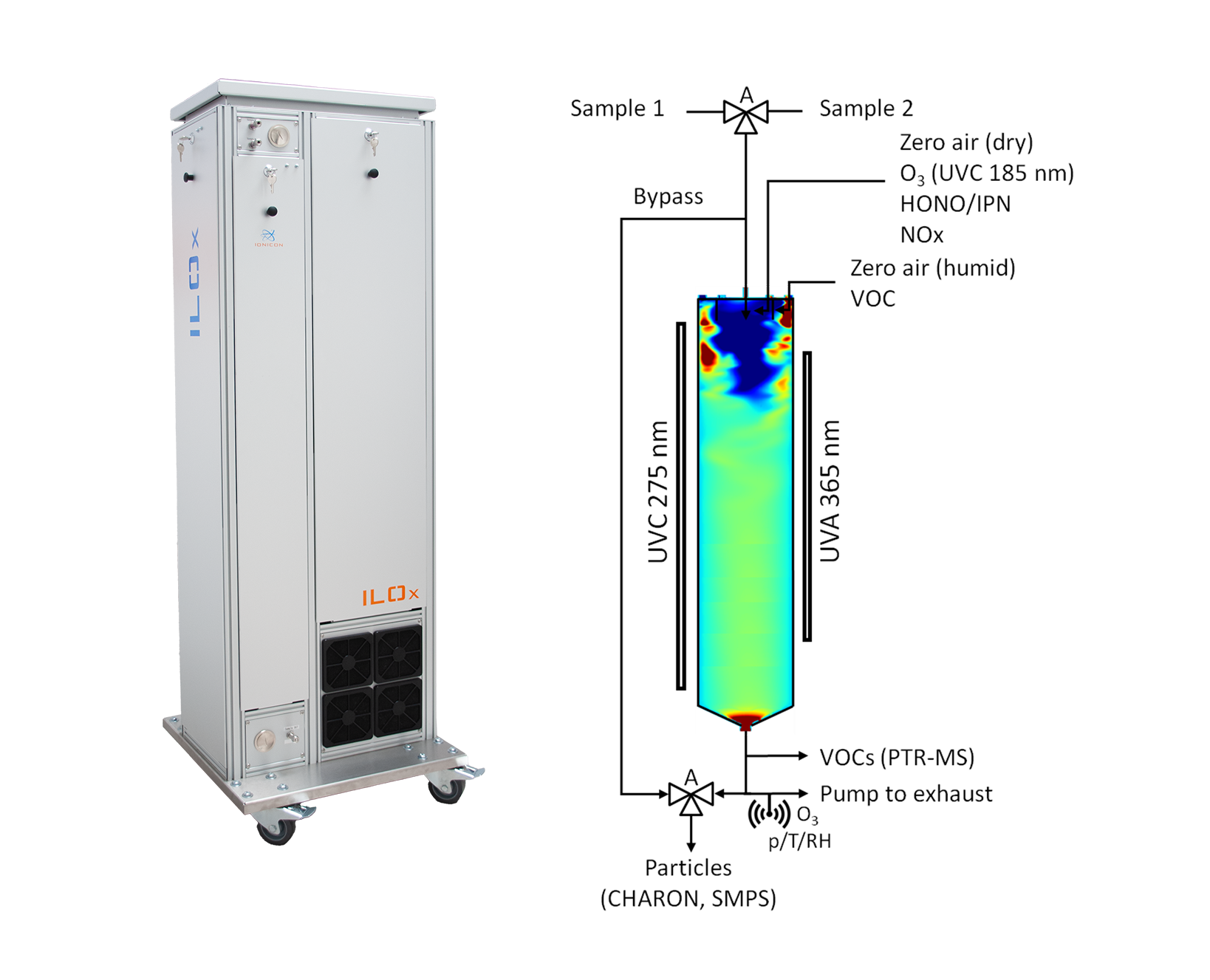
The ILOx is built around a 110-cm-long Quartz glass tube with a total internal volume of 8 L. To achieve a laminar flow condition inside the reactor, sheath air is injected by a circular motion, suppressing the formation of injection jets. Various oxidants and precursor compounds can be supplied via a series of mass flow controllers. Figure 1 shows a schematic diagram of ILOx including results of simulations of the flow regime inside ILOx. All materials are optimized for purest experiments and quickest response (Quartz glass, Teflon and passivated surfaces only). Three types of UV lamps power the photooxidation:
- an external Penray UVC lamp (185 nm): for production of O3 from 0 to 3 ppmv (manually adjustable)
- UVC LEDs (275 nm): for photolysis of O3 to produce OH in ILOx (software dimmable up to 40 W)
- UVA LEDs (365 nm): for photolysis of e.g. HONO or Isopropylnitrite (IPN) for OH formation and NOx cycling (manually dimmable up to 450 W)
To maintain near-ambient temperatures inside the ILOx reactor, active cooling by a set of fans is sufficient for relevant irradiation conditions.
Rapid Oxidation Capability
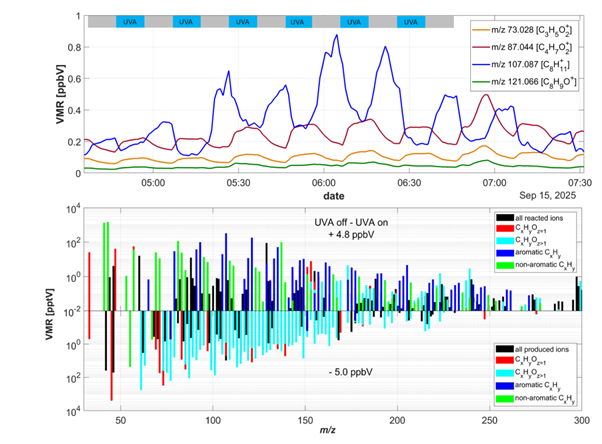
To experimentally confirm the rapid oxidation potential of ILOx, ambient air was actively sucked through ILOx at a flow rate of 2 l/min. For this experiment the photolysis of IPN was used to generate OH; UVA irradiation was periodically activated every ten minutes. VOCs were monitored by the FUSION PTR-TOF 10. Figure 2 shows a morning rush hour in Innsbruck, Austria. The top panel demonstrates the successful oxidation of xylene (C8H11+, blue trace) and the production of known oxidation products (e.g. methylglyoxal C3H5O2+, orange). Xylenes have an estimated atmospheric lifetime ranging from 0.5 to 2 days – hence a decay to 35% proves the rapid oxidation capability of ILOx. But, of course, not only xylene was detected by the FUSION PTR-TOF 10. The bottom panel shows difference-spectra (UVA off – UVA on) to quantify the amount of reacted (top) and produced (bottom) VOCs. Notably, VOCs that are reacted mostly consist of aromatic and non-aromatic hydrocarbons (e.g. toluene and monoterpenes), whereas most produced VOCs exhibit oxidized VOCs with O > 1 (e.g. acetic acid).
SOA Mass Yield
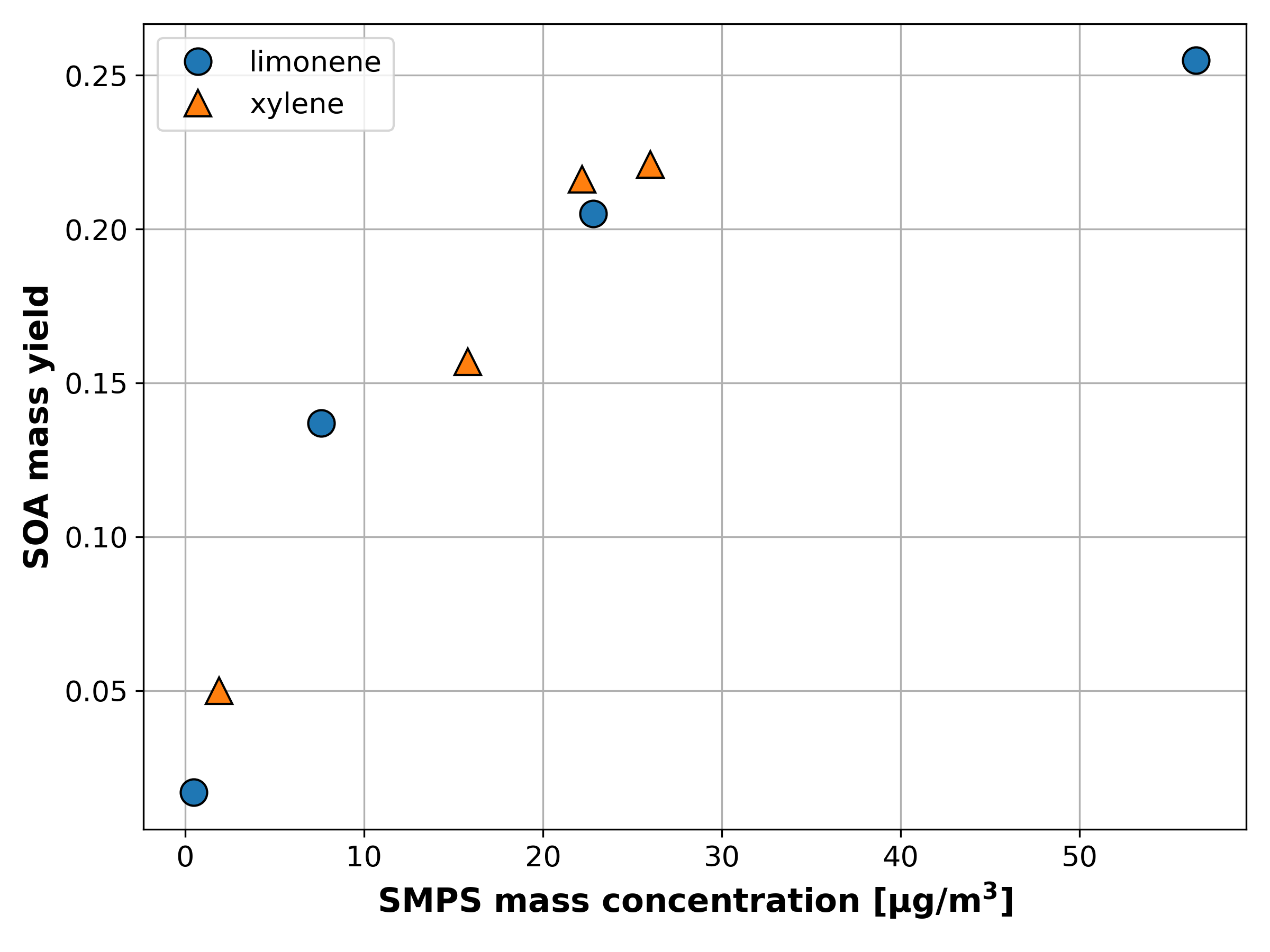
Limonene and o-xylene precursors were oxidized in ILOx without seed via photolysis of ozone (UVC 275 nm irradiation) at RH = 50%. The nucleated SOA was then measured by SMPS at ILOx’s dedicated particle sampling port. SOA mass yields, shown in Figure 3, match expectations from oxidation flow reactor (OFR) and smog chamber experiments.
Molecular Insights
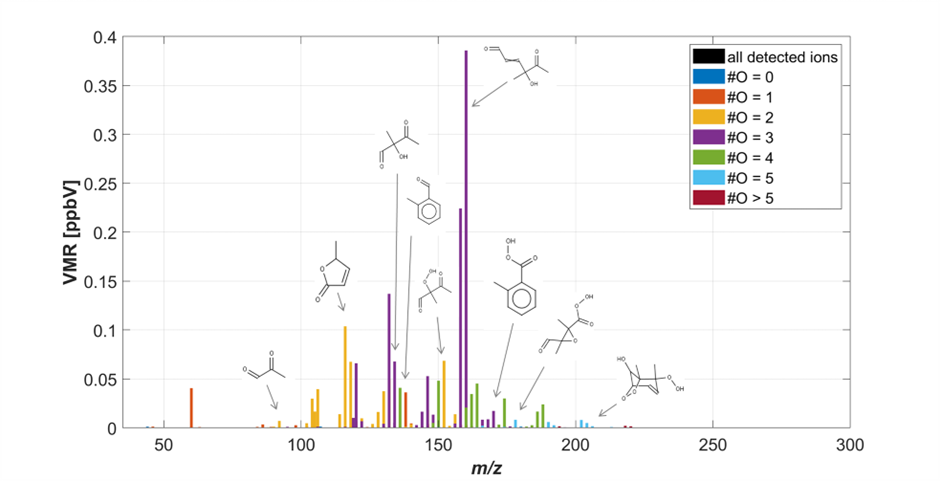
Soft adduct ionization with NH4+ conserves the chemical compositions of a plethora of oxidation products. Hence, no interferences with fragments hinder the interpretation of the recorded mass spectra. To demonstrate this with ILOx, an oxidation experiment with 25 ppbv of o-xylene in the presence of 170 ppbv of O3 and minimum UVC 275 nm irradiation (~7.5 W) was performed. Notably, under these low oxidation conditions only 10% of the initial o-xylene was consumed. This corresponds to an OH exposure of OHexp ~ 9 x 10⁹ molecules cm-3 s or approximately 1.6 h of atmospheric ageing. Figure 4 depicts the mass spectrum of the formed oxygenated VOCs, measured fragmentation-free as NH4+ adducts. Under those reaction conditions, volatile products containing three oxygen atoms dominate, but up to O6 products are well visible. Chemical compositions of the oxidation products match well with MCM 3.3.1 simulations.
Learn more about ILOx on the following posters:
Quantifying the Influence of IVOC and SVOC on Ambient SOA Formation
A versatile laminar-flow oxidation reactor for studying multiple-day
oxidation of atmospheric organics
Technical specifications
Reactor Details | - 8 L - Typical residence times: 2 to 16 min - CFD optimized circular sheath air injection - Optimized for VOC and SOA experiments - Integrated chip-based sensors for UV irradiation, temperatures, relative humidity, pressure and ozone |
| Consumable gases | - Purified or synthetic air (5.0 or better) - O2 for O3 formation (grade 5.0 or better) - OH-precursor (IPN, HONO, H2O2 solution, optional) - NOx or CO (ideally in ppmv range in N2, optional) - VOCs (ideally in ppmv range in N2, optional) |
Irradiation | - UVC 185 nm Penray for external O3 production |
| Power consumption | 600 W (excl. optional external pump) |
| Dimensions (W x D x H) | 520 mm x 540 mm x 1640 mm (with wheels) |
520 mm x 300 mm x 1520 mm (without wheels) | |
| Best to combine with | - FUSION PTR-TOF 10 or 20 - CHARON particle inlet |