


Dynamic Humidity Control (DHC)
How humidity levels can be stabilized in PTR-MS
Making PTR-MS humidity-independent
Humidity variations are a well-known source of uncertainty in Proton Transfer Reaction - Mass Spectrometry (PTR-MS). These fluctuations can alter ion chemistry and affect signal intensities, which makes quantitative interpretation more difficult.
Ionicon’s DHC technology stabilizes humidity within the PTR-MS reaction chamber in real time, offering a solution to this problem.
Overview of the Method
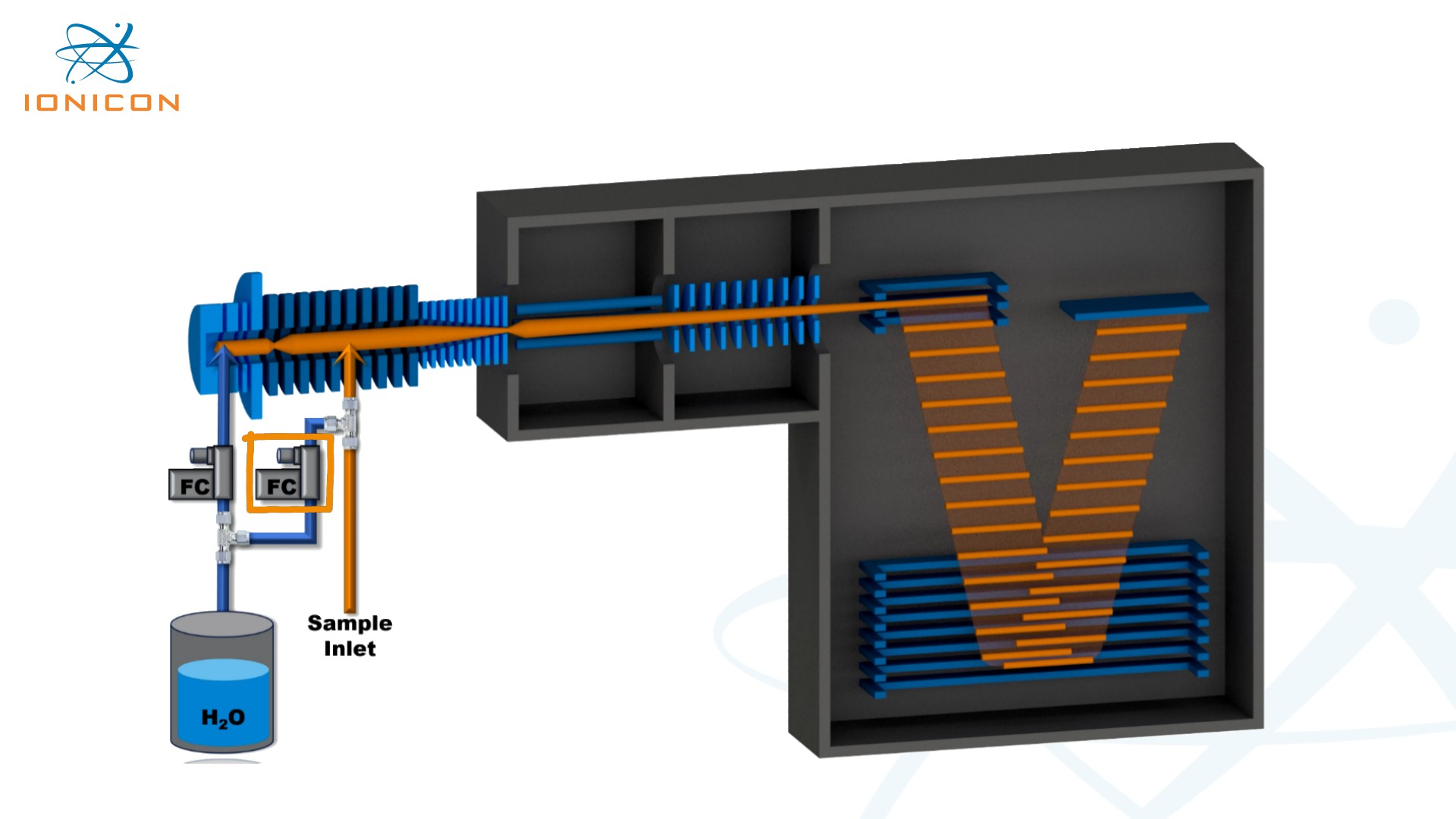
DHC introduces a controlled amount of water vapor into the drift tube and continuously monitors humidity levels. Based on these levels, DHC dynamically adjusts the internal water vapor levels to maintain consistent reaction conditions, regardless of the humidity in the sample gas. Watch the video for a more detailed explanation.
Advantages and Applications
- Eliminates the need for humidity-specific calibrations
- Reduces the need for sample pre-treatment, such as drying or humidification
- Improves long-term measurement stability and reproducibility
- Applicable across a wide range of sample matrices and environments
- International patent application WO2025251098 A1 (pending)
Empirical validation using hydrogen sulfide (H₂S) demonstrated consistent ion signal responses across a broad range of humidity levels, proving the efficacy of DHC in decoupling the effects of humidity from compound quantification.
This technology is particularly relevant for continuous ambient air monitoring, industrial process control, and research applications where humidity is variable or difficult to control.
For further insight on humidity-independent PTR-MS with DHC: Read the Full Blog Post
Discover the full range of possibilities offered by PTR-MS.